deep learning
Posts
- Is hiding your model weights behind a REST API actually secure? A technical deep dive into how AugSteal, linear algebra, and side-channels are dismantling MLaaS.
Background
-
Paper: A Novel Approach for Detecting Forged SMTP Headers using Deep Learning and Synthetic Data Generation
Accepted in the Main Track of SBSeg 2025, Brazil’s premier cybersecurity symposium, achieving the maximum distinction (Four Seals of Approval).
- Excellence: One of the select few papers to receive all four approval seals, validating its technical depth and innovation.
- Innovation: Proposed a new architecture combining Deep Learning and Synthetic Data to detect sophisticated phishing attacks.
- Recognition: Derived from my undergraduate thesis and presented in person in Foz do Iguaçu, representing CEFET/RJ.
-
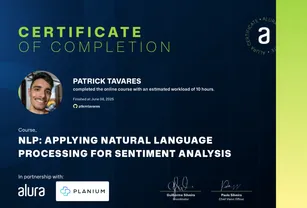
Provider: Alura
Focused on sequential data architectures, I utilized PyTorch to design and implement Long Short-Term Memory (LSTM) and Gated Recurrent Units (GRU), effectively addressing the vanishing gradient problem to maintain temporal dependencies in complex time-series and natural language tasks.
-
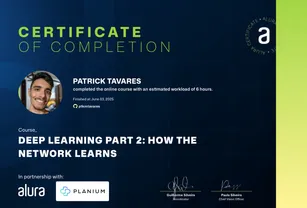
Provider: Alura
Deep dive into the mathematical mechanics of training. Explored the logic behind backpropagation, gradient descent, and the optimization of loss functions to adjust internal weights and ensure model convergence.
-
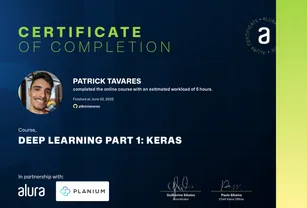
Provider: Alura
Practical implementation of neural networks using the Keras high-level API. Focused on data preparation, building Sequential models, and executing training cycles for supervised learning tasks.
-
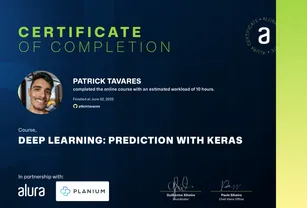
Provider: Alura
Applied Keras for predictive modeling, focusing on hyperparameter tuning, model evaluation metrics, and optimizing neural networks for high-accuracy forecasting in production environments.
-
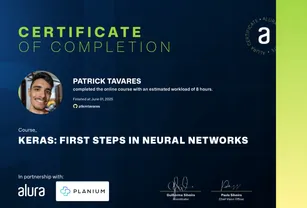
Provider: Alura
Foundational implementation of neural networks. Covered data preprocessing for deep learning, building sequential models, and understanding activation functions in a supervised learning context.
-
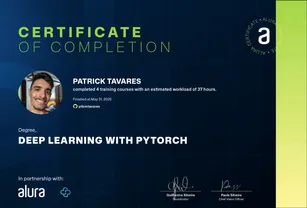
Provider: Alura
Comprehensive training covering the end-to-end lifecycle of deep learning models. Focused on tensor operations, building custom neural architectures, and implementing training loops using PyTorch for complex non-linear problems.
-
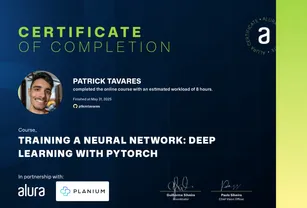
Provider: Alura
I mastered the mechanics of deep model optimization by configuring advanced solvers like Adam and SGD, while strategically applying regularization methods such as Dropout and weight decay to ensure robust generalization and prevent overfitting during the backpropagation process.
-
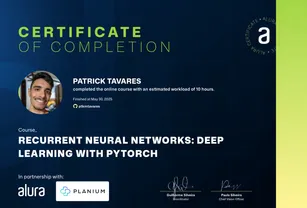
Provider: Alura
Focused on sequential data architectures, I utilized PyTorch to design and implement Long Short-Term Memory (LSTM) and Gated Recurrent Units (GRU), effectively addressing the vanishing gradient problem to maintain temporal dependencies in complex time-series and natural language tasks.
-
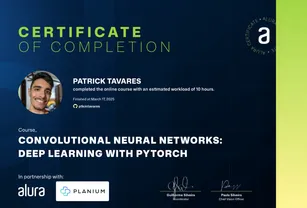
Provider: Alura
Advanced implementation of computer vision models. Focused on CNN architecture design, including convolutional layers, pooling, and dropout strategies for feature extraction and image classification tasks.
-
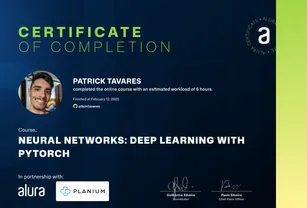
Provider: Alura
This certification focused on the low-level implementation of neural architectures using Tensors and computational graphs, where I leveraged the torch.nn module to construct Multi-Layer Perceptrons and define custom weight initialization strategies for non-linear classification challenges.